

Road Design and Infrastructure Defects: When the City of Los Angeles May Be Liable for Car Accidents
Most car accident claims begin with the drivers. Someone ran a red light, changed lanes too quickly, followed too closely, or failed to yield. But not every crash is caused by driver conduct alone. Sometimes the road itself helps create the danger.
A confusing intersection, missing sign, broken signal, poorly marked construction zone, or unsafe lane design can leave drivers with too little time to react. When unsafe public infrastructure contributes to a collision, guidance from a Los Angeles car accident lawyer can help determine whether a city, county, Caltrans, or another public entity may share responsibility.
When Road Design Makes a Crash More Likely
A dangerous road design does not always look dramatic. It may be an intersection where drivers cannot see approaching traffic until it is too late. It may be a turn lane that backs up into moving traffic, a merge area with too little warning, or a lane shift that surprises drivers at night.
These problems matter because safe driving depends on clear information. Drivers need time to see hazards, read signs, understand lane movements, and respond to other vehicles. When a roadway design gives drivers poor sightlines or confusing instructions, ordinary traffic can become dangerous very quickly.
In a personal injury claim, the issue is not simply whether the road could have been better. The question is whether the condition created an unreasonable risk and contributed to a foreseeable collision.
Faulty Traffic Signals and Missing Traffic Controls
Traffic signals and signs are supposed to bring order to busy roads. When they fail, drivers may enter an intersection without knowing who has the right-of-way or where traffic is supposed to move.
A broken signal can cause confusion in seconds. A missing stop sign, faded lane marking, blocked warning sign, or unclear turn arrow can create the same problem. In Los Angeles traffic, where drivers often make quick decisions at crowded intersections, a missing or defective traffic control can turn a manageable situation into a serious crash.
These claims often depend on what the public agency knew before the collision. Prior complaints, repair requests, maintenance logs, or earlier crashes can show whether the dangerous condition had already been reported and left uncorrected.
Dangerous Road Conditions and Poor Maintenance
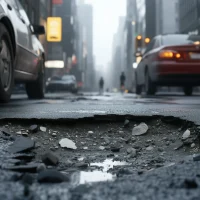
Some roadway hazards develop over time. Large potholes, uneven pavement, broken guardrails, damaged medians, loose debris, and poor drainage can all affect a driver’s control of a vehicle. A driver who hits a deep pothole or slides through standing water may lose control before understanding what happened.
Construction zones can create similar risks when temporary lanes are poorly marked or signs fail to guide traffic safely through the work area. A road that was safe under normal conditions can become dangerous when construction markings are confusing or incomplete.
The maintenance history often becomes a central part of the claim. Repair records, photographs, inspection reports, and prior complaints can help show whether the hazard existed long enough for the responsible agency to respond.
Why Government Liability Is Different
A claim against a public entity is not the same as a claim against another driver. Cities, counties, and state agencies have procedures and defenses that do not apply in ordinary car accident cases.
That does not mean a public agency is immune whenever a crash happens on a public road. A government entity may be responsible when a dangerous condition on public property contributes to an injury and the agency had notice of the hazard or created it through design, construction, or maintenance decisions.
The challenge is proving both the roadway problem and the government’s connection to it. A claim must show more than a bad road or a confusing intersection. It must connect the defect to the collision and identify the public entity responsible for that location.
Evidence That Shows the Road Played a Role
Roadway defect claims require evidence beyond the police report. The crash scene needs to be documented carefully because road conditions can change after an accident. Signs may be replaced, signals repaired, potholes filled, or construction markings removed.
Photographs, video footage, roadway measurements, signal timing records, maintenance logs, inspection reports, prior complaints, and collision history can help establish what made the location dangerous. Engineering plans or traffic studies may also show whether the area had known design problems.
Expert review can be important when the danger is not obvious. An engineer or accident reconstruction expert may evaluate sight distance, lighting, lane design, traffic flow, and impact location to explain how the roadway contributed to the crash.
Comparative Fault When Drivers and Road Conditions Both Matter
A roadway defect does not erase driver responsibility. California allows fault to be divided among multiple parties. A driver may have been speeding or distracted, while an unsafe intersection or malfunctioning signal still made the crash more likely.
This is where many government liability claims become contested. A city or agency may argue that the driver alone caused the collision. An insurance carrier may make the same argument to avoid responsibility or reduce the value of the claim.
A strong roadway defect claim addresses both sides of the issue. It does not ignore driver conduct, but it also does not allow an unsafe road condition to disappear from the liability analysis.
Government Claim Deadlines Can Be Short
Government claims move under strict timelines. For personal injury claims against public entities in California, written notice is generally required within six months of the injury before a lawsuit can proceed.
That shorter deadline can create serious problems for injured people who assume they have the same amount of time as an ordinary car accident case. By the time a dangerous roadway condition is identified, the claim deadline may already be approaching.
The responsible agency is not always obvious. A road may be controlled by the City of Los Angeles, Los Angeles County, Caltrans, or another public entity. Early review helps identify who controlled the roadway and what claim procedure applies.
Why Early Legal Strategy Matters in Roadway Defect Claims
Roadway defect cases need prompt investigation because the most important evidence is often outside the injured person’s control. Public agencies may hold maintenance records, traffic signal data, engineering documents, inspection reports, and prior complaints.
A strong roadway defect claim connects the unsafe condition to the collision, identifies the responsible public entity, and addresses the government claim requirements before deadlines become a barrier. Early review by a Los Angeles car accident lawyer helps determine whether unsafe infrastructure contributed to the crash and whether a public entity should be included in the claim.
Contact Kosnett Law Firm
If you or a loved one has been injured in a collision involving dangerous roadway conditions, you deserve clear answers and strong legal advocacy. At Kosnett Law Firm, we handle complex car accident claims involving disputed liability, roadway defects, and government entities.
Contact Kosnett Law Firm to speak with one of our trusted Los Angeles car accident lawyers today for a confidential consultation, and let us pursue the compensation available under California law.
